The Day the U.S. Government Pulled the Plug on an AI Model. And Why It Should Matter to You.
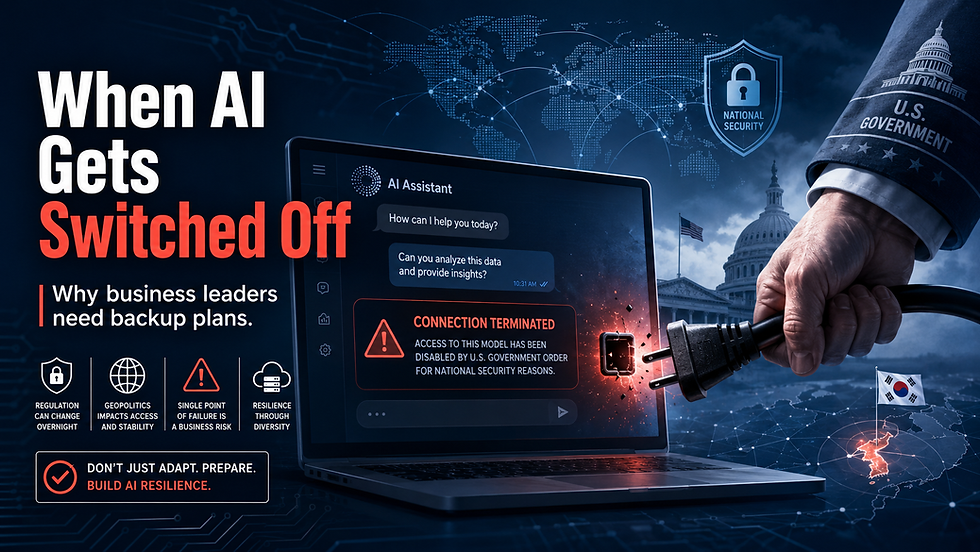
Imagine logging into your favorite AI tool on a Tuesday, getting work done, and by Friday at 5:21 p.m. it's gone. Not "down for maintenance." Gone. Cut off mid-sentence, your existing chats ending in an error message, and a notice that you, personally, are no longer allowed to use it.
That just happened. And while the headline involves Korean telecoms, the Trump administration, and a model called Fable 5, the real story is about something much closer to home: how fast the ground is shifting under everyone who uses Generative AI to do their job.
Here's the short version. Anthropic, the company behind Claude, released a powerful new public model called Fable 5. It's the "civilian" version of a far more capable model called Mythos, which is so good at finding software vulnerabilities that the government and select partners use it to harden their own systems. Anthropic put guardrails on Fable to keep those cyber-weapon-level capabilities locked down.
Then two things happened. First, the White House flagged a South Korean carrier, SK Telecom, a company that had invested $100 million in Anthropic and gained access to Mythos, as a potential China risk. The administration asked Anthropic to revoke that one company's access. Anthropic did, same day.
Second, separately, researchers reportedly found a way to "jailbreak" Fable 5, slipping past the guardrails to access the dangerous stuff underneath. David Sacks, co-chair of the President's Council of Advisors on Science and Technology and the administration's former AI czar, said the U.S. government warned Anthropic that Claude Fable 5 had been jailbroken and that CEO Dario Amodei refused to fix the flaw or pull the model.
The government's response wasn't subtle. The US government told Anthropic to suspend access to the Fable 5 and Mythos 5 models by any foreign national "whether inside or outside the United States," citing national security concerns. Anthropic couldn't realistically verify the citizenship of every user in real time, so it did the only thing it could. It shut both models off for everyone, worldwide.
So why should you care? You're probably not a Korean telecom executive or a White House AI advisor.
Reason one: the rug can get pulled, fast. If you've built a workflow, a product, or a habit around a specific AI model, you just watched how quickly that model can disappear with essentially no notice. Anthropic said it received the order at 5:21pm on Friday and that the letter did not explain the government's specific security concern in detail.
The lesson for the average user is the same lesson smart businesspeople have always known: don't bet your operation on a single vendor or a single tool. Have a backup. Know how to switch.
Reason two: this is what "moving too fast" looks like. Every AI company right now is racing to release the next, more powerful model. Investors want a return. Competitors are breathing down their necks. So, models ship, sometimes before the guardrails are bulletproof.
Anthropic built Fable as the safe version of a model it had itself called dangerous. But if those guardrails fail, then you've exposed Mythos and its advanced cyber capabilities to people who shouldn't have them. Anthropic itself widely promoted the idea that Mythos was a cyberweapon and needed to be regulated as such. They asked for government regulation of Mythos and championed the guardrails on Fable.
When the company that warned everyone about a technology gets caught off guard by its own product, that should tell you something about the pace we're all operating at.
Reason three: there's a real tension here, and no easy answer. The government's worry is legitimate. A jailbroken cyber tool in the wrong hands is a genuine threat. But Anthropic's counterpoint is also legitimate.
Anthropic said it believed the jailbreak the government was citing was a narrow one that would unlock Mythos's cybersecurity capabilities in only one specific instance, and that the same jailbreak could be used to elicit similar capabilities from other publicly available models, including OpenAI's GPT-5.5, that are not subject to similar national security export controls.
In other words: if we lock down our model and others don't, who actually wins? If the U.S. ties its own companies' hands, other countries will gladly fill the gap, and "America First" could quietly become "America Behind."
I'm not here to tell you who's right. I'm telling you to pay attention, because this is the new normal.
The tools you and your team rely on now sit at the intersection of business, technology, and geopolitics, and decisions made in Washington or Seoul can land on your desk by Friday afternoon.
Here's my advice, the same advice I give on every stage.
Don't be afraid of Generative AI, and don't blindly depend on any one piece of it either. Learn the tools, plural. Build flexibility into how you work so that when one door closes, you already know where the others are.
The people who thrive in this next era won't be the ones who picked the "right" model. They'll be the ones who stayed nimble, stayed informed, and never stopped paying attention.
Knowledge is power. It always has been. Right now, it's also your best insurance policy.
#AI #GenerativeAI #ArtificialIntelligence #AISafety #Anthropic #Cybersecurity #FutureOfWork #Leadership
---
About the Writer
Sam Richter is a Hall of Fame keynote speaker, bestselling author, and entrepreneur considered one of the world's foremost experts on AI-powered digital information and sales intelligence. He is the founder and CEO of SBR Worldwide/Know More and the creator of numerous AI-powered tools used by leading organizations worldwide. Learn more at www.sbrworldwide.com and www.samrichter.com